• Accountants & Finance Brokers est.1999
  • (02) 89578454
  • team@rideraccountants.com.au
Chartered Accountants Sydney for Property and BusinessRider Chartered Accountants SydneyChartered Accountants Sydney for Property and BusinessChartered Accountants Sydney for Property and Business
  • Individuals
    • Individual Tax
    • Should I Open a Self Managed Super Fund (SMSF)?
    • Cryptocurrency
    • Uber Drivers
    • “Golden” Tax Planning Structure Checklist
  • Business
    • Find a Small Business Accountant Sydney
    • Small Business Tax
    • Sole Trader with ABN
    • Uber Ride Share
    • XERO
    • Restructuring
    • Payroll
    • Tax Directory
    • Sell My Business
    • Forensic Accounting
    • Crowd-Source Funding
  • Property
    • Should I Use a Trust to Buy Investment Property?
    • Short-Term Rental Accommodation Accountant
    • What is the Land Tax by State in Australia?
    • Investment Rental Property Tax Deductions Top 20
    • AirBNB Tax & Accounting
    • Investment Property Loans
    • Order a Tax Depreciation Report
    • Investment Property and Tax
    • Tax Depreciation Report
    • Accountants Letter
    • Buying Property When Self-Employed
    • Real Estate Trust Fund Auditor
    • CGT Variation Form
  • About
    • About Us
    • Book an Accountant Online
    • New Client Engagement
    • Ad-Hoc Client Engagement Letter
    • Professional Fees
    • Employment Opportunities
    • Get in Touch
  • Blog
Book Now
✕
Is landscaping tax deductible?
Is Landscaping Tax Deductible?
February 4, 2026
Common SMSF paperwork mistakes
Don’t Let a Paperwork Blunder Kill Your SMSF Property Strategy
February 17, 2026
Published by Steven Rider at February 12, 2026
Categories
  • Small Business
Tags
  • negative gearing
  • property
  • tax planning
  • Trusts
Negative Gearing Trusts for Property Investors

Negative Gearing Trusts for Property Investors

When it comes to property investing in Australia, the “holy grail” for many is a structure that offers the asset protection of a trust without losing the immediate tax benefits of negative gearing.

If you hold a property in a standard Family (Discretionary) Trust, any rental losses are usually “trapped” inside the trust. This means you can’t use those losses to reduce the tax on your salary. However, a Negative Gearing Trust (sometimes called a “Fixed Entitlement” or “Hybrid” structure) is designed specifically to bridge this gap.

Here is a blog post by Rider Accountants that explains why this might be the right move for your portfolio.


Asset Protection Meets Tax Savings: Why Use a Negative Gearing Trust?

For the serious property investor, choosing how to hold your assets is just as important as what you buy. Traditionally, investors face a dilemma:

  1. Buy in your own name: You get the tax benefits of negative gearing, but your property is exposed to personal legal risks and creditors.

  2. Buy in a family trust: You get excellent asset protection and estate planning flexibility, but your negative gearing losses are “trapped” until the property becomes profitable.

But what if you could have both? Enter the Negative Gearing Trust.

What is a Negative Gearing Trust?

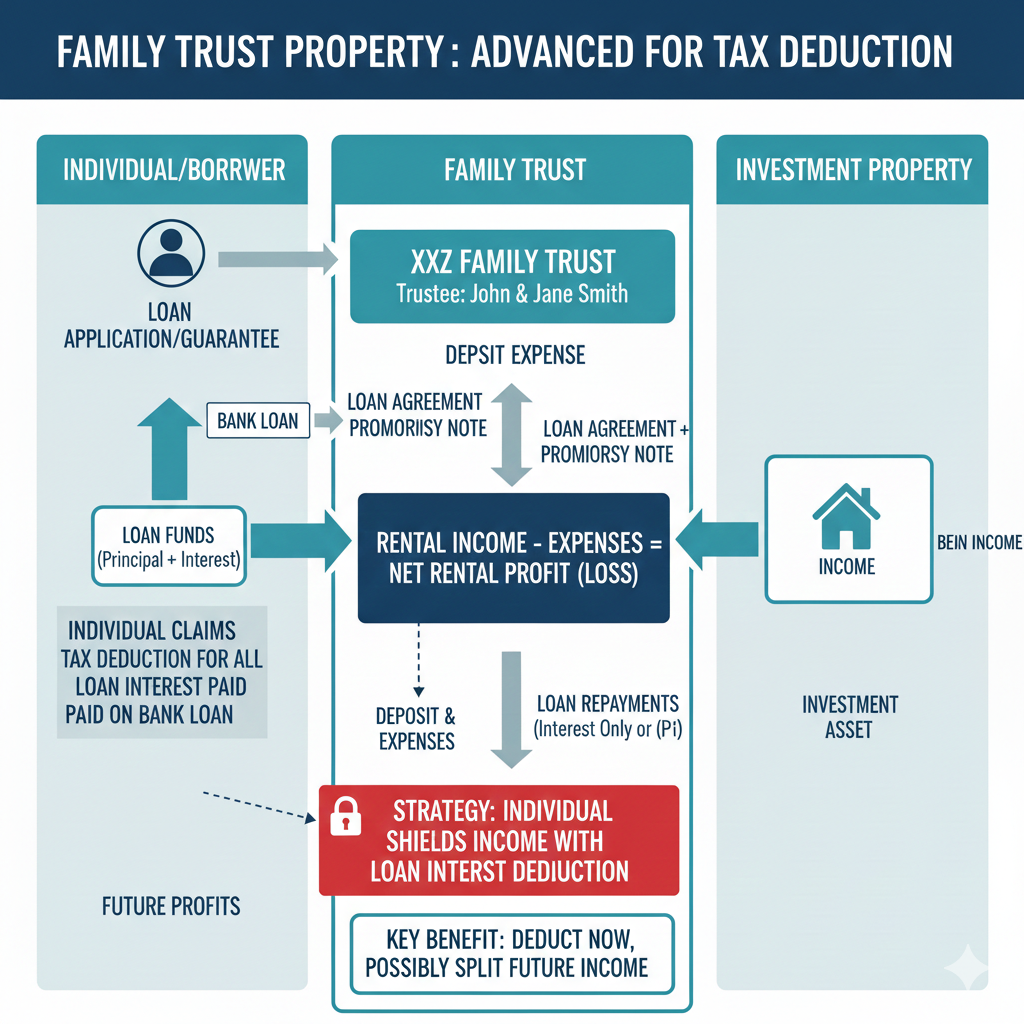
A Negative Gearing Trust is a specialised trust structure designed to satisfy the Australian Taxation Office (ATO) requirements for interest deductibility while keeping the asset itself within a protective trust environment.

In this arrangement, the investor typically borrows funds in their own name and on-lends them to the trust (or buys specific units in the trust) under very specific terms. This allows the individual to claim the interest expense on their personal tax return, effectively negatively gearing the investment.

4 Reasons Property Investors Use This Structure

1. Superior Asset Protection

The primary reason to use any trust is security. Because the property is legally owned by a trustee (often a shelf company) rather than you personally, it is generally shielded from personal creditors. If you are a business owner or a professional in a high-risk industry (like medicine or law), this “firewall” between your personal liabilities and your wealth is essential.

2. Immediate Tax Deductions

Unlike a standard discretionary trust where losses stay locked away, a correctly structured Negative Gearing Trust allows the individual beneficiary to claim the interest costs against their high-tax salary. This can result in significant tax refunds, which helps manage the cash flow of holding the property during those early, expensive years.

3. Future Income Splitting

While the trust acts like a “fixed” structure during the negative gearing phase, it can be designed to offer flexibility once the property becomes “positively geared” (profitable). At that point, the trust can potentially distribute surplus rental income to other family members in lower tax brackets, such as a spouse or adult children, significantly reducing your family’s overall tax bill.

4. Simplified Estate Planning

Properties held in a trust do not form part of your personal estate. This means that if you pass away, the property doesn’t necessarily need to be sold or transferred via a will, which can trigger massive Stamp Duty and Capital Gains Tax (CGT) events. Instead, you simply change the “control” of the trust, allowing your wealth to pass to the next generation seamlessly.

5. Why Use a Negative Gearing Trust?

Well it depends. Firstly, for asset protection. The asset will not be held in the individual’s name but instead in the trust. As such, the equity in the asset acquired in the trust could be substantially protected against claims against the individual especially if there is a corporate trustee of the trust. Secondly, individuals use it to obtain a tax deduction for borrowings made in their own name. Generally, individuals cannot claim a tax deduction for interest expenses incurred for assets held in discretionary trusts. A negative gearing trust is a special type of trust where an individual may be able to obtain a tax deduction for interest expenses incurred on the bank loan even though the asset is in the discretionary trust. The net income in the trust will be substantially less than the interest payable on the loan in the early years. This means the individual will get a tax deduction for substantially all of the interest payable on the loan. Thirdly, individuals use a negative gearing trust to give them flexibility to deal with surplus income and capital of the trust. Under a negative gearing trust structure any income that exceeds the interest payable on the loan can be distributed to a discretionary trust. From this discretionary trust the trustee can then distribute that surplus income in any manner it pleases. Similarly, any capital gains can be distributed to any beneficiaries under the trust. It doesn’t have to be the actual individual that made the initial loan to the trust. This is the case provided they recouped all the interest paid to the bank. 


Negative Gearing Trust to Claim Tax Deductible Interest

Summary 

The core message of this post is that while Negative Gearing is a powerful tax-saving tool for individuals, it works very differently (and often less effectively) within a Family Trust because losses are “quarantined.”

Breakdown of the Key Concepts

The blog highlights three main pillars you need to understand when deciding on a structure:

A. The “Trap” (Negative Gearing in Trusts)

  • The Rule: In a standard discretionary (family) trust, you cannot distribute a loss to beneficiaries.

  • The Result: If your property expenses are $40k and rent is $30k, the $10k loss stays inside the trust. You cannot use it to reduce the tax on your personal salary.

  • The Recovery: That loss is “carried forward” and can only be used to offset future income or capital gains made within that same trust.

B. The “Trade-Off” (Asset Protection vs. Tax Cashflow)

Investors often choose a trust despite the loss of immediate negative gearing benefits for two reasons:

    1. Asset Protection: The property is held by the trust, not you personally. This protects the asset from personal creditors or legal claims.

    2. Income Splitting: Once the property becomes positively geared (profitable), the trust allows you to distribute that profit.

C. Strategic Summary Table

FeatureIndividual NameFamily Trust
Negative GearingImmediate: Deduct losses from your salary.Delayed: Losses carried forward in the trust.
Asset ProtectionLow: Asset is at risk from personal creditors.High: Asset is legally separate from you.
Profit DistributionFixed: Taxed at your personal marginal rate.Flexible: Distribute to low-income beneficiaries.
Land TaxOften eligible for a threshold.Often pays from “dollar one” (state dependent).

Is it Right for You?

While the benefits are clear, Negative Gearing Trusts are complex. The ATO looks closely at these structures to ensure they are not being used solely for tax avoidance. To be effective, the trust deed must be meticulously drafted, and the “purpose” of the loan must be clearly documented.

Furthermore, some states (like NSW) have different Land Tax thresholds for trusts, so it’s vital to run the numbers with your property qualified accountant (e.g. Rider Accountants and Advisors) before you sign a contract.

How Rider Accountants Can Help

At Rider Accountants & Advisors, we specialise in helping Sydney property investors navigate complex tax structures. Because we are both Chartered Accountants and Mortgage Brokers, we look at your investment from both sides: ensuring your loan is structured for maximum deductibility and your trust is set up for maximum protection.

Ready to grow your portfolio safely? Book a digital consultation with Steven Rider today to discuss if a Negative Gearing Trust is the missing piece of your investment strategy.


Disclaimer: This article is general in nature and does not constitute financial or legal advice. Tax laws are subject to change, and you should always seek professional advice tailored to your specific circumstances.

Share
0
Steven Rider
Steven Rider

Related posts

Tax Planning used by the wealthy

Tax Planning used by the wealthy

March 19, 2026

Beyond the Bucket Company: Is the “Ultra” Tax Structure Right for Your Wealth Strategy?


Read more
What is Debt Recycling and Why is it Good for Tax?

What is Debt Recycling and Why is it Good for Tax?

March 13, 2026

Turning “Bad Debt” into “Good Debt”: A Guide to Debt Recycling for Property Investors


Read more
Active Bucket Company Test

Active Bucket Company Test

March 12, 2026

Setup an Active Bucket Company


Read more

Comments are closed.

2 Sydney Locations

Earlwood Office 15 Marana Road Earlwood NSW 2206
Marrickville Office 34D Fitzroy Street Marrickville 2204 Inner West Sydney Australia
Phone

(02) 8957 8454
0405 27 1969
© 2026 Rider Accountants & Advisors Trust | ABN 57 272 151 754 | CPA Public Practice Licence 2012560 | CA Licence 3177200
  • Tax
  • Small Business
  • Property
  • Sharing Economy
  • Privacy Policy
  • Terms of Use
  • Disclaimer
Book Now