You’ve worked hard to build your business and accumulate profit. But as many Australian business owners discover, getting that money out of your company and into your personal pocket is often harder than earning it in the first place.
At Rider Accountants & Advisors, we see many new clients who treat their company bank account like a personal ATM. Under Australian tax law, your company is a separate legal entity. If you take cash without a documented strategy, you aren’t just “moving money”—you’re potentially triggering a Division 7A disaster, inviting an ATO audit, and breaching your director’s duties.
Here is the Rider guide on the smartest ways to extract wealth from your company while staying fully compliant.
1. Salaries, Director Fees, and Superannuation
The most direct way to get paid is as an employee of your own company.
The Strategy: You pay yourself a market-rate salary or director’s fees.
The Benefit: These are tax-deductible for the company, reducing its taxable income.
The Rider Accountants Tip: Don’t forget Superannuation. Contributing to your super is one of the most tax-effective ways to move wealth out of a corporate structure and into your personal future. We can help you calculate the “sweet spot” between salary and super to minimize your overall tax position.
2. Dividends and Franking Credits
Dividends are the traditional way to distribute after-tax profits to shareholders.
The Strategy: The company pays tax (usually 25% for small businesses), and the remaining profit is distributed to shareholders.
The Benefit: Australia’s franking (imputation) system prevents double taxation. You receive a “franking credit” for the tax the company has already paid.
The Compliance Hurdle: Under Section 254T of the Corporations Act, you can only pay dividends if the company is solvent and the payment is fair to creditors. As your advisors, we ensure your financial statements are up-to-date in Xero so you know exactly what is available to distribute.
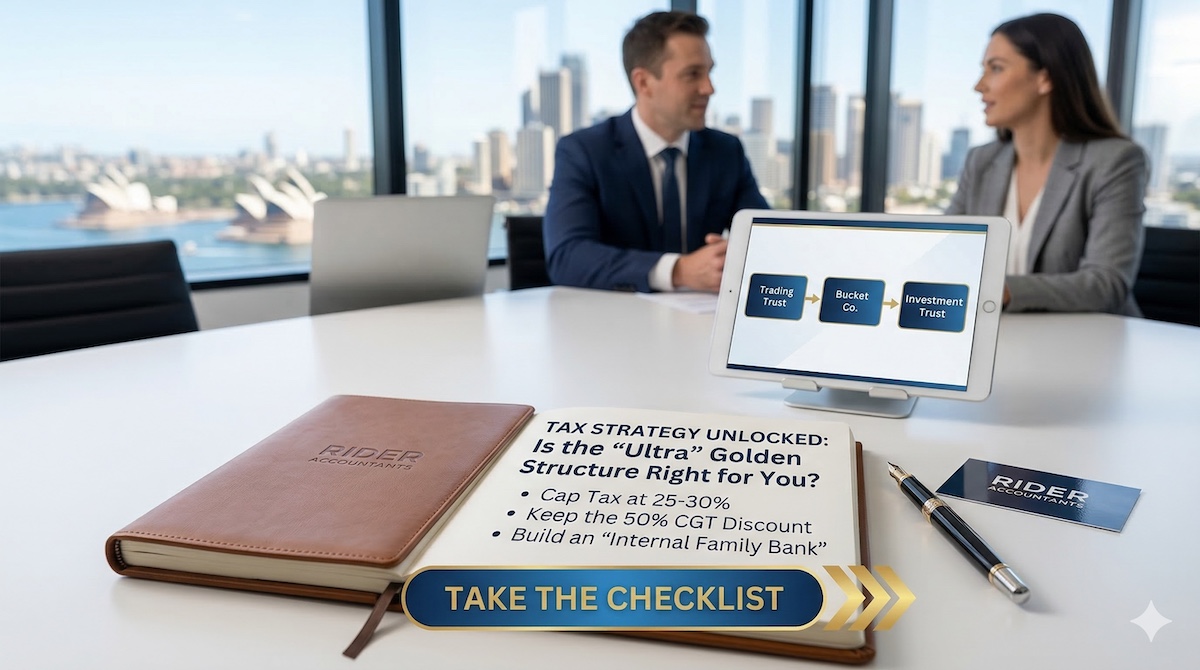
3. The “Bucket Company” and Family Trusts
If your company is owned by a Family Trust, you have significantly more flexibility.
The Strategy: Instead of distributing all income to individuals (who might be in the 47% tax bracket), the Trust distributes income to a “Bucket Company.”
The Benefit: You cap the tax rate at the corporate level (25% or 30%) rather than the high individual rates.
The Rider Advantage: We specialize in setting up and managing Discretionary Trusts and Corporate Beneficiaries. We ensure your Trust Resolutions are signed and stored digitally in your Client DropBox before the June 30 deadline.
4. Division 7A: The “Danger Zone”
If you “borrow” money from your company or use company assets (like a boat or property) for personal use, the ATO looks at this through the lens of Division 7A. Without the right paperwork, the ATO can deem that entire loan as an “unfranked dividend,” meaning you pay top-tier tax on it with no credits.
The Fix: A formal Division 7A Loan Agreement.
The Requirements: These loans must have a maximum term (usually 7 years), a benchmark interest rate set by the ATO, and strict annual minimum repayments.
Our Role: We manage the “UPE” (Unpaid Present Entitlement) investment agreements and ensure your loan repayments are tracked accurately every year to keep you out of the ATO’s crosshairs.
5. Repaying Shareholder Loans
If you put your own money into the business to get it started, you can take that money back tax-free.
The Strategy: This isn’t income; it’s a repayment of a debt the company owes you.
The Catch: You must have clear records (ideally a Loan Agreement) proving the money was a loan and not a gift or equity injection. Our digital accounting systems ensure these “at-call” loans are clearly identified on your balance sheet.
6. Claim Director Expense Reimbursements
This is a simple and non-taxable extraction. The company reimburses you for business-related expenses you paid for personally. This includes travel, office supplies, or vehicle costs.
This repayment is tax-free. It is a reimbursement, not income. The company claims a tax deduction for this reimbursement under section 8-1 of the ITAA 1997.
The Fringe Benefits Tax (FBT) Trap
This method is only for legitimate business expenses. If the company pays for or reimburses your private expenses (e.g., your home mortgage, holidays, or school fees), this triggers the Fringe Benefits Tax Assessment Act 1986 (Cth).
FBT is a separate, punitive tax paid by the company. It is levied at the highest marginal tax rate (47%) on the ‘grossed-up’ value of the benefit.
Why Work with Rider Accountants & Advisors?
Navigating the web of Division 7A, franking credits, and trust distributions requires specialist knowledge. At Rider, we provide:
Upfront Pricing: No hidden surprises—see our Professional Fees page for transparent costs.
Digital-First Service: From Zoom appointments to digital signing via our Google Cloud, we make compliance frictionless.
Specialist Advice: Whether you are a business owner, an Airbnb host, or a property investor, we tailor these strategies to your specific wealth goals.
Ready to plan your next distribution? Book a Zoom appointment with one of our Chartered Accountants or CPAs today. Let’s get your money working for you, not the ATO.